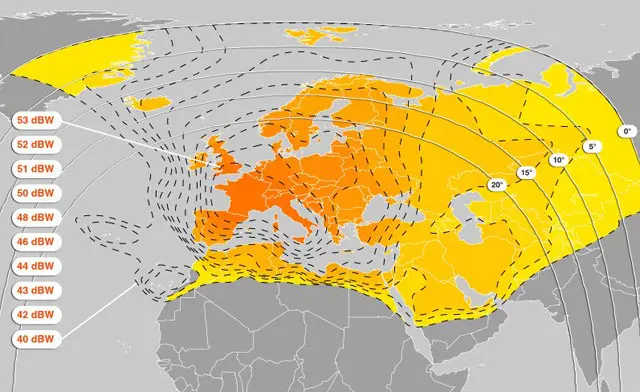
Hotbird is one of the most widely used communication satellites for broadcasting television and radio channels across Europe, the Middle East, and parts of North Africa.
Since its launch in 1995, the Hotbird satellite fleet has played a significant role in providing a wide variety of content, including free-to-air, subscription-based channels, and internet services.
With its strategic orbital position and advanced technology, Hotbird has established itself as a leader in the satellite broadcasting industry.
🚀 On the subject of Hotbird
Hotbird is operated by Eutelsat, one of the world’s leading satellite operators. The Hotbird satellite fleet consists of multiple satellites, such as Hotbird 13C, Hotbird 13B, and Hotbird 13E, which are positioned at 13° East longitude. This prime location allows Hotbird to provide coverage across large parts of Europe, the Middle East, and North Africa.
Hotbird offers an extensive array of services, including:
-
Television channels: A variety of TV channels, including news, sports, entertainment, and educational programming.
-
Radio broadcasting: Both FM and satellite radio services.
-
Data and internet services: Reliable internet and communication links for businesses and individuals.
-
Corporate communications: Private communication channels for corporate and government use.
🌐 Hotbird’s Satellite Fleet
The Hotbird fleet includes several satellites positioned in the same orbital slot at 13° East, which gives it an exceptional ability to serve a large area of coverage.
Key satellites in the Hotbird fleet include:
-
Hotbird 13B
-
Hotbird 13C
-
Hotbird 13E
-
Hotbird 13F (Upcoming)
These satellites are equipped with high-powered transponders that deliver a wide range of services across the broadcast and telecommunication sectors.
🛰️ Frequencies and Services on Hotbird
Hotbird offers services through several frequency bands, including the Ku-band and Ka-band. These frequencies are used for different purposes:
-
Ku-band: The most common frequency for satellite TV and radio services. It offers high-quality transmission with smaller dishes and supports high-definition (HD) channels and internet services.
-
Ka-band: Used for high-capacity data services and satellite internet, offering faster speeds and lower latency.
Hotbird’s wide range of frequencies enables users to access hundreds of television channels, radio stations, and internet services across a broad area.
📡 How to Receive Hotbird Signals
To receive signals from the Hotbird satellite, users need a satellite dish that is properly aligned to the 13° East orbital position. The dish should be connected to a compatible receiver, which will allow the user to tune in to the correct frequencies.
Common Hotbird Frequencies:
-
Hotbird 13C Frequency:
-
Frequency: 11.647 GHz (Horizontal)
-
Symbol Rate: 27500
-
FEC: 3/4
-
-
Hotbird 13B Frequency:
-
Frequency: 12.722 GHz (Vertical)
-
Symbol Rate: 27500
-
FEC: 3/4
-
These frequencies are used for a variety of services, including satellite TV channels, radio stations, and data transmission.
For precise information on the frequencies and satellite settings, FreqSatellite is an excellent resource that provides updated details for users looking to tune their satellite systems to Hotbird’s services.
Hotbird is a major player in satellite broadcasting, offering wide-reaching coverage and reliable services across Europe, the Middle East, and North Africa. Its fleet of satellites provides a broad range of services, including television, radio, internet, and data transmission, making it a key player in the communication industry.
If you are looking to set up a satellite system to receive Hotbird signals or need the latest frequency updates, FreqSatellite offers the most comprehensive guides and settings for all your satellite needs.
Understanding Beamwidth’s Effect on Broadcast Quality
Satellite beamwidth affects signal intensity and coverage. Narrow beams offer stronger signals for targeted areas, while wide beams cover larger regions.
1. Spot Beams
- Focused narrow beams provide high-quality reception for a specific region.
2. Wide Beams
- Cover broad areas but signal strength may be lower at the edges.
3. Implication for Dish Alignment
- Precise alignment is critical for narrow beams to maximize signal quality.
- Wide beams are more forgiving but may still require fine tuning for weak channels.
Impact of Receiver Power Supply Quality
A stable power supply ensures consistent operation of the receiver and proper decoding of satellite signals.
1. Avoiding Signal Fluctuations
- Low-quality or unstable power supplies can cause the receiver to reset or lose signal intermittently.
2. Prolonging Receiver Lifespan
- Stable voltage reduces wear on internal components and prevents overheating.
3. Choosing the Right Power Supply
- Always use the manufacturer-recommended adapter or a high-quality equivalent with correct voltage and amperage.
Causes of Weak Satellite Signals and How to Solve Them
Weak satellite signals can disrupt your viewing experience. Identifying the causes helps restore stable reception.
1. Dish Misalignment
- Even a slight deviation from the correct satellite position can weaken the signal.
2. Poor Quality Cables or Connectors
- Check for corrosion, loose connections, or damaged coaxial cables.
3. LNB Issues
- Replace old or low-gain LNBs to improve signal quality.
4. Environmental Obstacles
- Tall trees, buildings, or other structures can block or reflect signals.
Difference Between SD and HD Broadcasts in Signal Usage
Standard Definition (SD) and High Definition (HD) broadcasts require different bandwidths and signal strength. Understanding this helps optimize reception.
1. SD Channels
- Require lower bandwidth and are less demanding on signal quality.
- Easier to receive in weak signal areas.
2. HD Channels
- Consume more bandwidth and need stronger, stable signals for clear picture.
- Prone to interruptions if signal fluctuates.
How to Improve Reception of Geographically Distant Channels
Channels from distant satellites may be weaker. Proper techniques can enhance signal strength and stability.
1. Use a Larger Dish
- Large dishes capture weaker signals more effectively than smaller ones.
2. High-Gain LNB
- Low-noise, high-gain LNBs improve reception for distant or weak signals.
3. Accurate Alignment
- Fine-tune azimuth, elevation, and skew angles to maximize signal quality.
How to Accurately Adjust a Motorized Dish
Motorized dishes allow access to multiple satellites. Proper alignment ensures maximum signal quality and channel stability.
1. Set Initial Position
- Align the dish to the first satellite using a fixed reference or compass.
2. Fine-Tune with Receiver
- Use the receiver’s signal meter to adjust azimuth and elevation until quality peaks.
3. Program Satellite Positions
- Store satellite positions in the motor controller for easy switching.
- Check each satellite individually to confirm optimal reception.
Common Mistakes Leading to Signal Loss and How to Avoid Them
Simple mistakes can disrupt satellite reception. Awareness helps prevent interruptions.
1. Loose or Corroded Connectors
- Regularly check and tighten all F-connectors to ensure a secure connection.
2. Incorrect Dish Alignment
- Even minor misalignment can cause channels to disappear.
3. Using Low-Quality Cables
- Invest in good coaxial cables with proper shielding to reduce interference.
Impact of Atmospheric Pressure on Broadcast Signals
Atmospheric conditions, including pressure, humidity, and temperature, affect satellite signal propagation and reception quality.
1. Signal Attenuation
- Low pressure and high humidity can slightly weaken signals, especially at higher frequencies.
2. Temporary Interference
- Rapid changes in atmospheric pressure may cause minor disruptions in signal stability.
3. Mitigation
- Use a high-gain LNB and properly sized dish to minimize atmospheric effects.



Accurate and updated satellite information every time.
Great satellite frequency updates. Everything works perfectly every time.
The step-by-step tuning guide helped me a lot. Very clear instructions.
Accurate updates for HD channels across multiple satellites.
Thanks for the clear frequency tables. Very easy to tune channels.
Excellent coverage of new satellite channel launches.
I successfully added missing channels thanks to your guide.
Your updates on new channel launches are always fast and accurate.
Your site saved me time when searching for missing channels.
Thanks for the clear frequency tables. Very easy to tune channels.
Your updates on new channel launches are always fast and accurate.
Great resource for satellite TV frequency news.
Great satellite frequency updates. Everything works perfectly every time.
I always visit your site before doing a manual channel search.
Your website makes it very easy to follow new satellite changes.
Your frequency tables are clean and easy to understand.
Very accurate satellite frequency updates. I tuned all channels without any issues.
I successfully restored my favorite channels using your guide.
Excellent coverage of new satellite channel launches.
Very helpful explanations about polarization and symbol rate.
I successfully added missing channels thanks to your guide.
Very reliable source for Nilesat and Hotbird frequencies.
The step-by-step tuning guide helped me a lot. Very clear instructions.
Your frequency tables are clean and easy to understand.
Accurate updates for HD channels across multiple satellites.
Great job updating HD and SD channel frequencies so quickly.
Very helpful explanations about polarization and symbol rate.