
In today’s interconnected world, satellites are the backbone of global communication, enabling seamless data transmission, television broadcasting, and secure military communications. Türksat, Turkey’s premier satellite operator, has emerged as a key player in this domain, bridging Europe, Asia, and Africa with cutting-edge technology. Operated by Türksat Uydu Haberleşme Kablo TV ve İşletme A.Ş. (Türksat A.Ş.), the Türksat satellite system exemplifies Turkey’s commitment to technological advancement and global outreach. This article delves into the history, technological evolution, services, and impact of the Türksat satellite system, with a special focus on Türksat 6A, Turkey’s first domestically produced communications satellite. 🚀
The Genesis of Türksat Satellites 🛠️
Early Beginnings
Türksat’s journey into satellite communications began in the early 1990s, marking Turkey’s ambitious entry into the global space arena. The first satellite, Türksat 1A, launched on January 24, 1994, was lost due to a launcher failure. Undeterred, Türksat successfully launched Türksat 1B on August 11, 1994, positioning it at 42°E. Operational by October 10, 1994, Türksat 1B featured 16 Ku-band transponders, enabling television and radio broadcasting, data transmission, and telephony services across Turkey, Central Europe, and Central Asia. 📡
Expanding Horizons
The loss of Türksat 1A led to the deployment of Türksat 1C on July 10, 1996, initially at 31.3°E before being repositioned to 42°E. This satellite expanded coverage, facilitating direct connections between Europe and Central Asia. In 2001, Türksat 2A (Eurasiasat 1) was launched, equipped with 34 high-powered transponders, including steerable beams for broader coverage. These early satellites laid the foundation for Türksat’s growing influence in the global satellite market. 🌐
Evolution of the Türksat Fleet 🌟
Türksat 3A: A Technological Leap
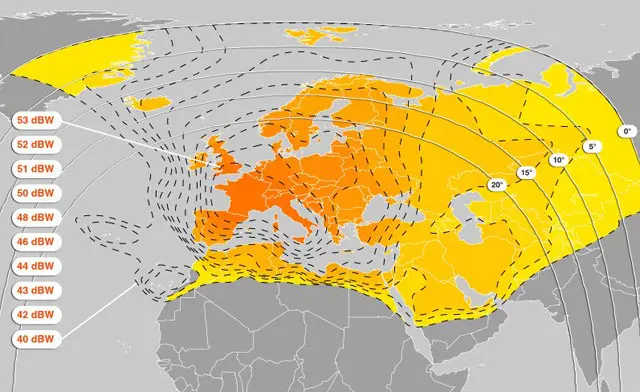
Launched on June 12, 2008, by Arianespace, Türksat 3A was a significant milestone. Built by Thales Alenia Space, it features 24 Ku-band transponders with a bandwidth of 1296 MHz. Positioned at 42°E, it serves Turkey, Europe, the Middle East, North Africa, and Central Asia, supporting broadband applications like VSAT services. Its design emphasizes cost-effective uplink systems, making it ideal for commercial and governmental use. 📺
Türksat 4A and 4B: Global Reach
Türksat 4A, launched on February 14, 2014, from Baikonur Cosmodrome, was constructed by Mitsubishi Electric Corporation (MELCO). Weighing 4,910 kg, it operates with 28 Ku-band, two Ka-band, and several C-band transponders. Its coverage spans from China to England, including Turkey, Europe, Central Asia, the Middle East, and Africa. The Ka-band transponders enable high-bandwidth communication, particularly for southern Africa, and support military broadcasting. Türksat 4B, launched in 2015, complements these capabilities, further strengthening Türksat’s global footprint. 🛡️
Türksat 5A and 5B: Modernizing Connectivity
Launched in 2020 and 2021, respectively, Türksat 5A and 5B were developed by Airbus. These satellites enhance broadband services and support Turkey’s growing digital economy.
With advanced transponder technologies, they provide robust communication infrastructure for both civilian and military applications. 🌐
Türksat 6A: A National Milestone 🏆
A Symbol of Self-Reliance
Türksat 6A, launched on July 8, 2024, aboard a SpaceX Falcon 9 from Cape Canaveral, Florida, marks a historic achievement as Turkey’s first fully domestically produced communications satellite.
Developed by TÜBİTAK Space Technologies Research Institute (TÜBİTAK Uzay), Turkish Aerospace Industries (TAI), ASELSAN, and CTech Bilişim Teknolojileri A.Ş., Türksat 6A positions Turkey among the 11 countries capable of manufacturing communication satellites. 🇹🇷
Technical Specifications
-
Weight: 4,260 kg
-
Position: 42°E
-
Transponders:
-
16 Ku-band transponders (plus 4 in reserve), uplink: 7.3–18.1 GHz, downlink: 11.7–12.75 GHz, minimum power: 140 watts
-
3 X-band transponders (2 active, 1 in reserve), minimum power: 150 watts, exclusive to Turkish Armed Forces
-
-
Coverage Zones:
-
West: British Isles to the Caspian Sea
-
East: Anatolia to China
-
Additional: India, Thailand, Malaysia, Indonesia
-
-
Population Reach: Over 5 billion people
Development and Testing
Türksat 6A’s development involved significant domestic expertise. TAI handled the satellite’s structure, thermal control, propulsion, and mechanical ground equipment.
TÜBİTAK Uzay and TAI collaborated on software for onboard data handling and command control.
Assembly and testing occurred at TAI’s Satellite Assembly Integration and Test Facility in Ankara, training a new generation of Turkish engineers and fostering innovation. 🛠️
Services and Applications 📡🌐
Broadcasting Excellence
Türksat satellites power national and international television and radio channels, including TRT, ATV, Kanal D, and Show TV.
The Türksat Channel Update System (TKGS) simplifies channel scanning for compatible receivers, enhancing user experience. 📺
Broadband and Data Services
Türksat’s VSAT system provides audio, data, internet, intranet, e-health, e-education, emergency communication, VPN, and multimedia services.
This system is critical in regions with limited terrestrial infrastructure, offering cost-effective solutions for public and private sectors. 🌍
Military Communications
The X-band transponders in Türksat 6A ensure secure, high-speed communication for the Turkish Armed Forces, enhancing national security. 🛡️
Global Impact and Future Prospects 🌟
Türksat’s satellites have transformed Turkey into a regional hub for satellite communications, fostering economic growth, digital inclusion, and international collaboration.
The successful launch of Türksat 6A not only strengthens Turkey’s technological independence but also expands its influence to over 5 billion people across three continents.
This achievement paves the way for future innovations, including potential advancements in satellite miniaturization, AI-driven communication systems, and sustainable space technologies. 🚀
Looking ahead, Türksat aims to further enhance its satellite fleet, focusing on higher bandwidth, improved coverage, and eco-friendly designs.
By investing in domestic talent and international partnerships, Türksat is poised to remain a leader in the global satellite industry, connecting the world one signal at a time. 🌐
How to Test Elevation Angle Accurately
Correct elevation ensures optimal alignment with the satellite and maximum signal quality.
1. Use a Compass or Receiver Meter
- Set the dish elevation according to satellite coordinates.
2. Fine-Tune While Monitoring Signal
- Adjust slowly up or down to peak signal strength and quality on the receiver meter.
3. Lock Position After Testing
- Tighten all bolts carefully to avoid misalignment due to wind or vibration.
How to Choose Between Aluminum and Steel Dishes
Dish material affects durability, weight, and reception quality. Choosing the right type depends on your needs and environment.
1. Aluminum Dishes
- Lightweight and resistant to corrosion.
- Easier to mount in exposed areas.
2. Steel Dishes
- Heavier, more robust, and less prone to bending.
- May require anti-rust coating in humid environments.
Difference Between Manual and Automatic Dish Tuning
Both methods have pros and cons. Choosing the right one depends on your receiver and personal preference.
1. Manual Tuning
- Allows precise control over frequency, polarization, and azimuth adjustments.
- Useful for advanced users or weak signals.
2. Automatic Tuning
- Scans and adds all available channels automatically.
- Faster and simpler, but may miss some specific frequencies.
Importance of Using a Protective Lens for the LNB
A protective cap shields the LNB from dust, rain, snow, and UV exposure, prolonging its lifespan and maintaining signal quality.
1. Weather Protection
- Prevents water infiltration and corrosion in rainy or snowy conditions.
2. Dust and Debris Prevention
- Stops dust, leaves, and small particles from affecting the LNB’s surface.
3. Prolongs LNB Lifespan
- Reduces maintenance needs and ensures stable performance over time.
Importance of Using a Lightning Protector for Satellite Systems
Lightning or electrical surges can damage your LNB, receiver, or TV. Protecting the system ensures safety and longevity.
1. Install Between Dish and Receiver
- Connect the lightning protector inline with the coaxial cable coming from the dish.
2. Ground Properly
- Ensure the protector is grounded according to local safety standards.
3. Regular Inspection
- Check for damage or wear after storms to maintain protection.
Reasons for Slow Channel Scanning
Slow scanning can frustrate users and delay setup. Identifying causes helps speed up the process.
1. Weak or Fluctuating Signal
- Low signal strength prolongs scanning as the receiver struggles to lock onto channels.
2. Receiver Performance
- Older or low-performance receivers may scan more slowly.
3. Number of Transponders
- Satellites with many transponders take longer to scan, especially if network scan is used.
Best Tilt Angle for Your Satellite Dish Based on Location
The correct LNB skew angle improves signal quality and reduces interference. Adjust based on geographic coordinates.
1. Determine Latitude
- Your local latitude affects the ideal dish tilt angle.
2. Calculate Skew
- Use online calculators or satellite maps to find recommended LNB rotation.
3. Fine-Tune While Monitoring Signal
- Adjust slightly while observing signal strength for maximum reception.
Causes of Weak Satellite Signals and How to Solve Them
Weak satellite signals can disrupt your viewing experience. Identifying the causes helps restore stable reception.
1. Dish Misalignment
- Even a slight deviation from the correct satellite position can weaken the signal.
2. Poor Quality Cables or Connectors
- Check for corrosion, loose connections, or damaged coaxial cables.
3. LNB Issues
- Replace old or low-gain LNBs to improve signal quality.
4. Environmental Obstacles
- Tall trees, buildings, or other structures can block or reflect signals.



Your site saved me time when searching for missing channels.
Very accurate satellite frequency updates. I tuned all channels without any issues.
Great resource for satellite TV frequency news.
I successfully restored my favorite channels using your guide.
Your frequency tables are clean and easy to understand.
Thanks for the clear frequency tables. Very easy to tune channels.
Thanks for the quick updates about frequency changes.
Reliable source for checking Nilesat frequency updates anytime.
Accurate and updated satellite information every time.
Great job updating HD and SD channel frequencies so quickly.
Excellent coverage of new satellite channel launches.
The step-by-step tuning instructions are extremely helpful.
The step-by-step tuning guide helped me a lot. Very clear instructions.
Your site saved me time when searching for missing channels.
Your updates on new channel launches are always fast and accurate.
Very accurate satellite frequency updates. I tuned all channels without any issues.
Your site saved me time when searching for missing channels.
Great satellite frequency updates. Everything works perfectly every time.
Very reliable source for Nilesat and Hotbird frequencies.
Thanks for the quick updates about frequency changes.
I successfully added missing channels thanks to your guide.
I always visit your site before doing a manual channel search.
Your website makes it very easy to follow new satellite changes.
Great satellite frequency updates. Everything works perfectly every time.
Very reliable source for Nilesat and Hotbird frequencies.
Great resource for satellite TV frequency news.
Accurate and updated satellite information every time.
Thanks for the quick updates about frequency changes.
Thanks for sharing the latest transponder details. Everything worked perfectly.
Reliable source for checking Nilesat frequency updates anytime.
I successfully added missing channels thanks to your guide.
Your updates on new channel launches are always fast and accurate.
Great resource for satellite TV frequency news.
I successfully restored my favorite channels using your guide.
I successfully restored my favorite channels using your guide.
Very reliable source for Nilesat and Hotbird frequencies.
Great resource for satellite TV frequency news.
Very reliable source for Nilesat and Hotbird frequencies.
Very accurate satellite frequency updates. I tuned all channels without any issues.